

“As above, so below” — but is that really what was written?
Astrology, alchemy, Hermetic philosophy, traditional Chinese medicine, indigenous medicine, Vastu, Feng Shui, and Ayurveda all explore the ways energy, balance, and natural forces shape life. While some focus on the cosmos, others focus on the Earth and the human body, yet the underlying idea is the same: everything is connected.
One ancient text, the Emerald Tablet, expresses this principle clearly: what is above and below are not merely analogous, but continuously arise from and influence each other.
Most people know the phrase ‘As above, so below,’ but the original text goes further, describing the unity of all things, the link between the microcosm and the macrocosm, and the hidden nature of matter and spirit — the very ideas these traditions study and apply.
As above, so below.
It comes from the Emerald Tablet, a text attributed to Hermes Trismegistus.
The Latin version reads:
Quod est superius est sicut quod est inferius…
That which is above is like that which is below.
The key word is sicut — “like.” It implies analogy, reflection, resemblance.
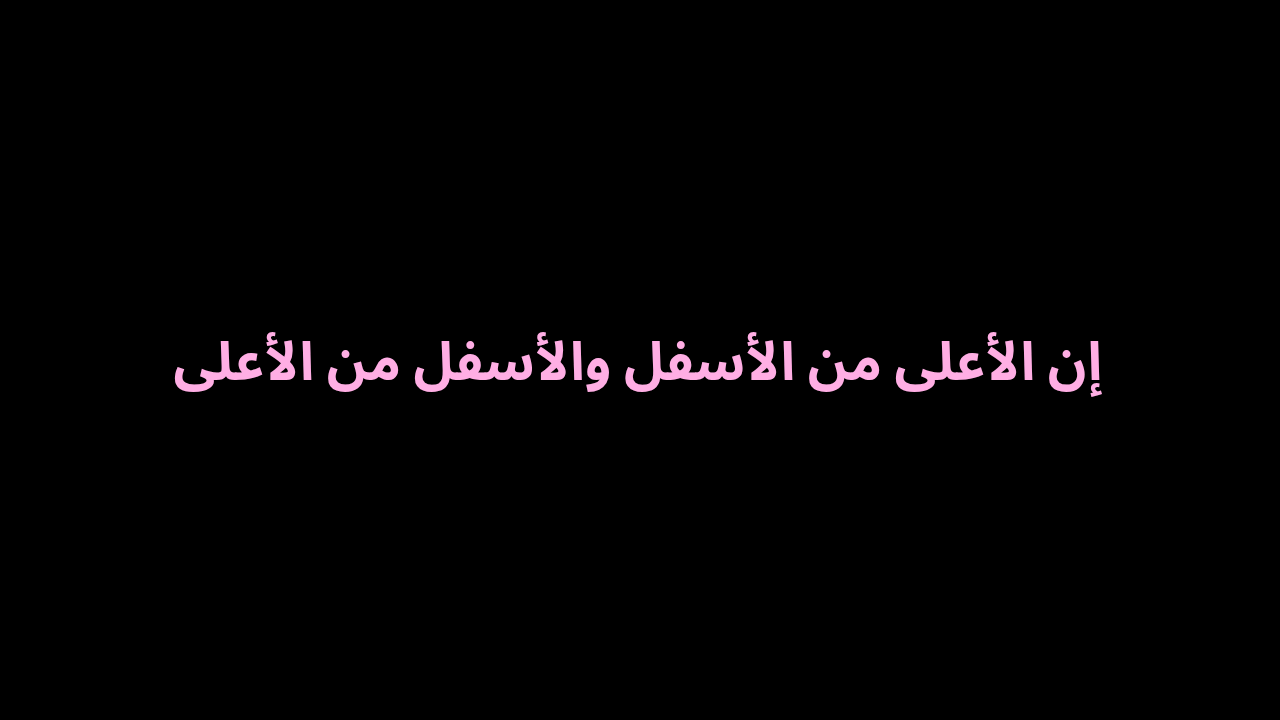
However, an early Arabic version, preserved in the tradition associated with Jabir ibn Hayyan, states:
إن الأعلى من الأسفل والأسفل من الأعلى
Literally:
That which is above is from that which is below,
and that which is below is from that which is above.
The word min (من) means “from,” “out of,” or “arising from.”
This is no longer a direct comparison. It suggests a relationship of derivation or emergence.
So we are faced with two distinct formulations:
•The Latin version presents a world of correspondence — above and below mirror one another.
•The Arabic version presents a more dynamic relationship — the above is from the below, and the below from the above.
The difference is subtle, yet significant. One emphasizes symbolic analogy. The other suggests reciprocal relation.
For this reason, “as above, so below” may not capture the full nuance of the Arabic wording.
Below is the full Arabic passage, followed by the English translation by Eric John Holmyard, published in 1923 in Nature (Vol. 122, pp. 525–526).
Arabic Text
حقا يقينا لا شك فيه
إن الأعلى من الأسفل والأسفل من الأعلى
عمل العجائب من واحد كما كانت الأشياء كلها من واحد
وأبوه الشمس وأمه القمر
حملته الأرض في بطنها وغذته الريح في بطنها
نار صارت أرضا
اغذوا الأرض من اللطيف
بقوة القوى يصعد من الأرض إلى السماء
فيكون مسلطا على الأعلى والأسفل
English Translation (Holmyard, 1923)
Truth! Certainty!
That in which there is no doubt!
That which is above is from that which is below, and that which is below is from that which is above, working the miracles of one [thing].
As all things were from One.
Its father is the Sun and its mother the Moon.
The Earth carried it in her belly,
and the Wind nourished it in her belly,
as Earth which shall become Fire.
Feed the Earth from that which is subtle,
with the greatest power.
It ascends from the earth to the heaven
and becomes ruler over that which is above
and that which is below.
-The first accurate English translation of the Arabic text is by Holmyard, 1923.
All other English translations (Ficino, Blavatsky, modern authors) use the phrase “As above, so below”, which is an idiomatic version rather than a literal translation.
The difference between Holmyard’s translation and the idiomatic versions is linguistically and philosophically significant:
Holmyard: from / arising from → emphasis on cause / origin
Idiom: as / like / correspondence → emphasis on analogy / reflection
The wisdom of ancient texts can be fragile in translation. Countless ancient , sacred and philosophical works have been altered — sometimes inadvertently, sometimes deliberately, and sometimes so profoundly that their meaning is fundamentally changed.
The Emerald Tablet is no exception.
To truly understand it, one must engage with the original language and the deeper philosophy it embodies.
Surface readings, or simplified idioms like “As above, so below,” can never capture the depth, subtlety, or transformative power of the original insight.
True knowledge demands study, careful reflection, and a respect for the text’s full complexity.
-Tea Franca