

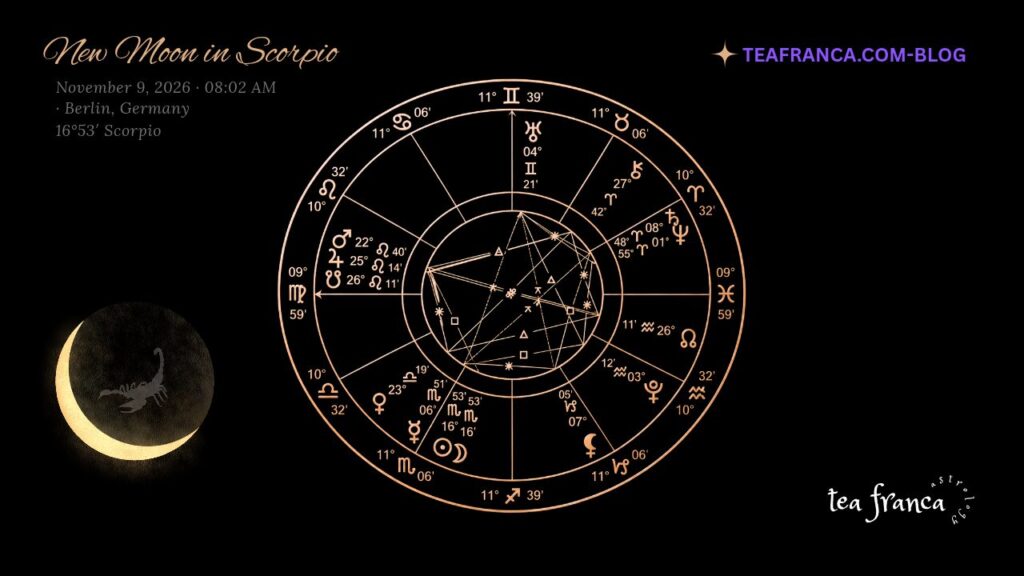
New Moon in Scorpio – November 9, 20268:02 AM CET
When I look at the astrological picture of this New Moon in Scorpio, I don’t feel we are dealing with an ordinary lunar cycle, one that simply marks the end of something and the beginning of something else.
There is a much deeper story unfolding beneath the surface, one that touches the very nature of power, the stories we tell ourselves, and the invisible forces that shape both our individual lives and the world we inhabit.
There is a strong sense of what is moving underneath, to listen to what is not being said. Sometimes this can be unsettling and overwhelmingly stimulative. But that inner tension is the point.
Once you have sensed that something is not quite as it appears, it becomes difficult to look away.
Every time around Scorpio lunations, the subconscious becomes louder. Dreams become vivid, emotionally charged, and I wake up feeling almost overwhelmed by the emotional imprints and archetypal images they leave behind. Lately, I’ve been writing poetry, and all of this connects me more deeply with my inner world.
Our inner world is significant and deserves our attention, not only during such lunations, but in general.
Scorpio is a feminine (Yin) sign, and this has nothing to do with biological sex or gender. The feminine principle, in its essence, is associated with receptivity, inwardness and the unconscious – with the hidden dimensions of the psyche that exist beneath our conscious awareness. Scorpio expresses this principle through emotional depth, instinct, shadow, psychological intensity and the process of bringing what has been repressed into consciousness.
Here, I want to emphasise that intuition and emotion are also forms of intelligence, even though they are so often undervalued by the rational, outward-moving, analytical mind associated with Yang. Yin and Yang represent universal principles through which life expresses itself and experience unfolds. They are not opposing forces engaged in a struggle for dominance, but complementary dimensions of existence, each carrying an intelligence and a function that the other cannot replace.Yin allows us to turn inward, to listen, to sense and to receive what cannot always be grasped through rational thought. It is the intelligence of feeling, intuition, imagination and the unconscious. Yang, on the other hand, gives form to experience through action, discernment, conscious thought and purposeful direction. One receives and processes; the other articulates and acts.Neither is complete without the other. When Yang dominates, we may become disconnected from our emotional and instinctual nature, attempting to understand everything through analysis and control. When Yin is denied, we lose access to an essential dimension of knowing – the subtle intelligence that allows us to sense what is happening beneath the surface before we can put it into words.Perhaps the deeper invitation is not to privilege one principle over the other, but to restore their relationship. To recognise that not everything meaningful can be explained, measured or rationally understood, and that sometimes the deepest form of knowing begins with the willingness to listen inwardly.
When we lose contact with Yin, an imbalance begins to emerge. Disconnected from our inner world, we may continue moving outward, acting and striving without a deeper sense of direction or inner alignment. In the absence of Yin’s receptive and intuitive wisdom, Yang can become excessive, driven by the need to control, achieve and impose direction rather than responding to a deeper inner knowing.
We may remain productive, rational, and constantly in motion, chasing success, yet become disconnected from the very source that gives meaning to what we create.
Yin is essential to creation itself.
Before anything can be brought into existence, there must be a period of inward movement – a gathering, a drawing in, a gestation. Think of the magnetism of a star being born: an inward gravitational pull, drawing matter towards itself, gathering everything into a centre until something new can emerge. And when, boom, the star is born, its energy begins to radiate outward.
Creation follows this rhythm, too: inwards and outwards.
There is a time to turn inward, to receive, to allow something to take shape in the unseen. And there is a time to move outward, to express and manifest it.
In order to birth something, we have to allow for the inward time.
The Scorpio New Moon invites us there.
The Distortion of Power
Disconnection from our inner world is perhaps where all distortion begins.
Scorpio lunations have a way of drawing us into the depths of ourselves. They unsettle what has grown stagnant, bringing us face to face with all that lies beneath the surface. Not always gently, but through the alchemy of dissolution, they strip away what is false, revealing what has always remained true at the very essence of the soul.
Power, desire and vulnerability are deeply intertwined in Scorpio’s psychological landscape. The desire to possess, control or dominate often emerges from a much more vulnerable place: the fear of loss, rejection, exposure or dependence.
What appears as strength can sometimes be an attempt to protect a part of ourselves that feels powerless.
Scorpio Moon wants to bring us into contact with these hidden dynamics.
South Node Activation
Mars and Jupiter in Leo are activating the South Node, while Pluto in Aquarius forms significant aspects to Mercury in Scorpio, Uranus in Gemini and Neptune in Aries.
These configurations speak of power, authority and influence – from our personal relationship with recognition, control and vulnerability to the political structures and collective narratives shaping our world.
Power, desire and vulnerability are closely intertwined, both in our personal lives and in the political and social structures that shape the collective.
The desire to lead, influence or be recognised can express confidence and creative strength, but it can also conceal a fear of vulnerability, insignificance or loss of control.
When expressed from the heart, Leo embodies the courage to create, inspire and stand in one’s individuality. There is nothing wrong with wanting to lead, shine or be recognised. The distinction lies between confidence in one’s own worth and the need for constant external validation.
When recognition becomes an obsession, confidence can turn into arrogance, and the desire to inspire into a need to command.
Mars and Jupiter amplify ambition, competition and the pursuit of influence. Together in Leo, they can magnify both the courage to lead and the need to defend one’s status and authority.
Their activation of the South Node brings familiar patterns of power back into focus.
Some may once have provided security, recognition or a sense of identity, but what once served us may no longer have a place in what comes next.
Sometimes we continue to defend an old position, or an image simply because we have invested so much of ourselves in it.
In this case, I would pay particular attention to established models of leadership, domination and the concentration of power.
They may be approaching a point where maintaining the old arrangement becomes increasingly difficult.
But what exactly are we being asked to reconsider?
I find the psychological dimension of this particularly compelling.
When the Self-Image Is Threatened
The ego is an important centre of our conscious identity. We need a sense of self to navigate the world.
Yet somewhere along the way, we can become so attached to the image we have constructed of ourselves that protecting that image becomes more important than discovering who we actually are.
Over time, we become attached to these identities, and more precisely, to the ego structures that help maintain our sense of who we are. We build careers, relationships, families, political identities and entire ways of life around certain images of ourselves.
Sometimes, we spend years defending them, even when our inner experience has already begun to change.
The problem begins when our sense of worth becomes too closely tied to maintaining a particular self-image. Criticism can then feel like humiliation, disagreement like a threat, and listening becomes difficult because it might require us to question something fundamental about ourselves.
When unconscious material, particularly aspects of the shadow, begins to enter consciousness, it can challenge the established self-image and the beliefs that hold it together.
The ego may respond with resistance, denial or other defence mechanisms, precisely because integrating this material requires us to acknowledge aspects of ourselves that we have previously rejected, repressed or failed to recognise.
This can be a deeply unsettling process.
When the discrepancy between our conscious self-image and unconscious material becomes too great, it can contribute to an identity crisis or a period of psychological disorientation.
Shadow work is not necessarily something everyone is equally ready for.
It requires psychological flexibility, a certain capacity for self-reflection, and the willingness to tolerate discomfort without immediately retreating into familiar defences.
The more rigidly we are attached to our established self-image, the more challenging this process of integration can become.
Take the need to dominate.
Behind it, there may be insecurity, a fear of losing control, or an old wound around recognition.
I think this is worth remembering when observing people in positions of authority.
You can learn a great deal about someone by watching what happens when they have power. Can they tolerate disagreement? Can they admit a mistake? Can they recognise another person’s perspective without feeling diminished by it? Or does every challenge become a threat to their sense of self?
Some people seem almost incapable of self-reflection. They rarely question their own motives, yet have no difficulty judging everyone around them.
This is one of the most important aspects of inner work: becoming able to see ourselves without constantly having to protect the image we have built of ourselves.
True inner work does not make us superior. It gradually makes us less dependent on feeling bigger than everyone else. True shadow work will change our relationship with fame, stripping away the need for the kind of validation this world has taught us to seek. It will make us more dangerous when it comes to manipulation, crossing boundaries and refusing what violates us. It will not make us calmer, kinder, always smiling or more agreeable. It will free us from people-pleasing, from the need to perform goodness and appear nice, and from societal and familial expectations that we must always be accepted by others.True shadow work will not eliminate our anger or aggression. Read that again. It will teach us to distinguish between the desire to hurt someone without reason ( a trait often associated with psychopathy!) – and the ability to recognise what our anger and aggression are protecting, and, when necessary, to use them with precision: to confront, resist and stand our ground.
But these patterns do not exist in isolation.
What plays out within individuals becomes embedded in the structures we create, shaping how societies organise authority, distribute resources and maintain control.
The same dynamics that operate on a personal level can take collective form, influencing political systems, institutions and the ways power is exercised and maintained.
This is where Pluto in Aquarius becomes meaningful.
While Scorpio invites us to examine the hidden psychological roots of power, Pluto in Aquarius expands this inquiry to the collective level. It raises questions about how power is organised and distributed within communities, institutions, technological networks, financial structures, and systems of social organisation.
The focus shifts from the individual’s relationship with power to the ways power operates within society itself: who holds it, how it is maintained, and how established structures can be challenged or transformed.
In this sense, Pluto in Aquarius does not introduce an entirely new theme. It extends the Plutonian exploration of power from the psychological and individual dimension into the collective sphere, revealing how deeply our personal patterns can be reflected in the systems we create and participate in.
Pluto in Aquarius
Pluto first entered Aquarius on March 23, 2023, made its final transition into Aquarius on November 19, 2024, and will remain there until March 8, 2043, before briefly returning to Aquarius later that year.
Remember how much was written about technological revolutions? Artificial intelligence, radical changes in social organisation and the transformation of power? These were among the central themes astrologers associated with Pluto’s journey through Aquarius.
We are now living through the early years of this transit, and I have a feeling that we are only beginning to understand its implications.
Pluto takes us beneath the visible structures. It reveals what has been operating in the background, the forces that sustain a system, the interests that remain protected even when everything on the surface appears to be changing.
One of the most important themes of this period is the Leo–Aquarius axis of the lunar nodes.
It describes the tension between individual authority and collective power. Leo wants to lead, to be recognised and to occupy a visible position. Aquarius draws our attention towards communities, networks, collective participation and different ways of organising society.
With the North Node in Aquarius and Pluto moving through Aquarius, we are looking at a symbolic shift away from familiar models of personal dominance and towards a reassessment of how power is distributed.
The contrast is particularly interesting.
The Leo model places considerable emphasis on the individual who leads, represents or embodies authority. The Aquarius principle asks us to look towards the collective, the network, the community and the structures through which people participate in decisions affecting their lives.
The North Node in Aquarius directs our attention towards people and their actual needs. They want representation and a genuine say in decisions that affect their lives. They want institutions that work, decisions that can be questioned and people in positions of authority who understand the responsibility that comes with their office.
A politician is elected to serve the people, not to rule over them. Public office is a responsibility, not a licence to command.
Mars and Jupiter activating the South Node in Leo bring familiar models of personal dominance and prestige into focus.
Pluto in Aquarius, meanwhile, speaks to a much deeper transformation of the structures that sustain them.
But there is something else we need to consider…
Pluto is not a symbol of beauty, but of the deep evolutionary need to confront the patterns that no longer support our growth. Can humanity build different social structures if it is not willing to transform its own relationship with power, control, belonging, and freedom?
The transformation of systems today involves information, knowledge, artificial intelligence, digital infrastructure, and financial and communication networks.
Technology enables broader access to knowledge, which is an enormous opportunity.
At the same time, transforming human consciousness is essential for transforming the systems themselves. Why do we surrender our authority to others, look for external saviours, abandon our own thinking in exchange for belonging, and choose conformity over freedom?
Because if we change only the system while maintaining the same patterns of consciousness, we will simply reproduce old models of power in a new form.
Replacing individual leaders does not necessarily transform the structures through which power operates. It may simply take different forms. An individual can lose influence while the institutions, financial networks, technological platforms and systems of information that support their authority remain untouched.
Positional power belongs to individuals occupying positions of authority. Structural power resides in the systems that determine who can exercise authority, how resources are distributed and which decisions become possible.
Changing the face at the top while leaving the system untouched is not much of a revolution.
Pluto contact Mercury – Uranus – Neptune
For me, one of the most fascinating parts of this configuration is Pluto’s relationship with Mercury in Scorpio, Uranus in Gemini and Neptune in Aries.
I see these connections as three dimensions of the same story, unfolding through different layers of collective experience.
•Mercury brings us to information and the construction of reality.
•Uranus takes us to the technological systems through which information circulates and power is exercised. (Uranus, in turn, is disposed by Mercury in Scorpio.)
•Neptune introduces the collective beliefs, ideals and narratives that give these systems meaning and legitimacy.
In other words, we need to look at what people know, how they receive that knowledge and what they are encouraged to believe.
PLUTO SQUARE MERCURY/LUCIFER
Mercury rules communication, media, negotiations, documents, trade and the exchange of information.
Asteroid Lucifer entered Scorpio and forms a conjunction with Mercury, while Mercury approaches its direct station and its square to Pluto.
Lucifer is the light-bearer, but his light can also blind and deceive.
In conjunction with Mercury in Scorpio, this symbolism may manifest as distorted perception, misinterpretation of information and intellectual blindness. With both Mercury and Lucifer square Pluto, the potential for psychological manipulation, distorted narratives, information control and the misuse of knowledge as an instrument of power deserves particular attention.This configuration may also draw attention to confidential information, propaganda, intelligence activities, secret negotiations, censorship, information warfare and the deliberate manipulation of public perception.
For example:
Who controls the architecture of information, and to what extent do cyberattacks, media narratives, and institutional responses contribute to shaping public perception, and who is driving the transition towards the digital euro and which institutions are advocating for its implementation ?
More importantly, how do crises reshape public attitudes towards security, surveillance, financial control, and institutional authority?
Because understanding what happens is only part of the equation. Understanding who frames events, who benefits from the climate of fear that follows, and how public consent is shaped is where Pluto’s true domain begins.
Pluto does not merely observe the changing faces of power; it exposes the enduring structures that sustain it. This is quintessential Pluto/Scorpio territory: power, control, secrecy, psychological manipulation, fear, hidden agendas, financial systems, and the exposure of what operates beneath the surface.
Information has become one of the most valuable instruments of political, economic and social influence. The ability to shape what people see, read and believe is inseparable from the ability to exercise power.
Pluto asks us to look beyond the information itself and consider the interests behind it.
Uranus is associated with technological innovation, science, digital networks and developments that challenge established ways of doing things.
Its trine to Pluto connects innovation with deeper structural change. I wouldn’t interpret this simply as a period of exciting technological discoveries or more sophisticated gadgets. The implications are much greater.
Artificial intelligence, automation, digital infrastructure and the centralisation of data are not merely transforming institutional operations and human communication; they are reshaping the very architecture of power, authority and social organisation.
Technology is becoming an increasingly powerful intermediary in decisions governing employment, education, healthcare, finance, security and access to essential services. Through algorithmic systems, data-driven assessments and automated decision-making, technological infrastructures increasingly shape how individuals are evaluated, classified, prioritised and granted or denied opportunities.But Pluto’s inquiry goes far beyond technological capability. It penetrates the architecture of power embedded within these systems: who designs and controls them, whose interests their algorithms serve, what forms of authority are encoded into their logic, who has access to the data, and who remains subject to decisions they cannot see, question or influence.
From a Plutonian perspective, the critical transformation is the gradual relocation of power into infrastructures that operate largely beyond public visibility.
The question is not simply how technology changes society, but how control, dependency and authority are reconfigured through technology itself.
What happens to individual freedom when more aspects of our lives become dependent on systems we neither own nor fully understand?
I think we need to educate ourselves more and become more critical of the language surrounding “technological progress”.
Technological progress and human progress are not necessarily the same thing.
A society can become extraordinarily advanced while its people become increasingly dependent on systems over which they have very little control. A technology that makes our lives easier but gradually takes away our ability to make independent choices deserves a closer look. A technologically advanced society is not necessarily an autonomous society.
The astrological significance lies in this chain of dispositorship: Uranian change is channelled through Mercury, while Mercury’s expression is ultimately coloured by Pluto.
During my recent visit to the Academy and its library in Vienna, I came across some educational material that I felt compelled to share with you. Something about it stayed with me, and I think it is particularly relevant to the questions raised by this configuration.
✉️ Coeckelbergh, M. (2026). “Technofascism: AI, Big Tech, and the New Authoritarianism” . AI & Society, 41, 5163–5176.
But even if we understand who controls information and the technologies through which it circulates, there is still another dimension to consider. Why do people accept it? What makes them believe in particular political narratives, ideals or visions of the future?
Pluto Sextile Neptune: Who Shapes Our Collective Beliefs?
Neptune represents collective ideals, beliefs, ideologies, dreams, our relationship with the divine and the way we imagine the future.
Its sextile to Pluto points towards a gradual transformation of the beliefs and values that shape society.
But I wouldn’t look at this aspect through rose-coloured glasses.
Neptune has its more difficult expressions: idealisation, confusion, illusion and the tendency to believe something because we desperately want it to be true. One possibility worth considering is the idealisation of technology, war, the glorification of sacrifice and the mobilisation of people around causes they may not fully understand. Neptune can blur the boundaries between facts and beliefs. Aries gives those beliefs an impulse to fight.
Whose ideals are we prepared to sacrifice ourselves for, and whose interests are actually being served?
I would be careful about interpreting this aspect simply as some “heart on fire” awakening.
Our ideals can inspire us – but they can also make us vulnerable to manipulation.
Venus -`♡´- finally – stations direct!
Venus transit:
•August 6 Enters Libra
•September 10 Enters Scorpio
•August 31 Enters pre-retrograde shadow at 22°52′ Libra
•October 3 Stations retrograde at 8°29′ Scorpio
•October 25 Re-enters Libra, retrograde
•October 24 Inferior conjunction with the Sun at 0°45′ Scorpio
•Around October 29–30 Heliacal rising as Morning Star, around 27° Libra
•November 14 Stations direct at 22°52′ Libra
•November 27 Maximum brightness as Morning Star
•December 4 Re-enters Scorpio
•December 15 Leaves post-retrograde shadow at 8°29′ Scorpio
Her emergence as the Morning Star brings a more outward, active and initiating expression of Venusian desire.
Life feels better now. 🙂
After the inward journey of retrogradation, Venus begins to turn towards the world again, carrying a deeper awareness of what she values, what she desires and what she is no longer willing to compromise.
As she continues her retrograde passage through Libra, our attention is drawn to the relational patterns that shape our lives. We may become more aware of where we have sought validation through others, or where maintaining harmony has required us to abandon ourselves.
Her sextiles to Jupiter in Leo and Mars in Leo, on November 4 and 10, respectively, bring greater warmth, confidence and initiative into this process. These aspects create a harmonious interplay between desire, action and expansion, encouraging us to pursue what we value with greater confidence, enthusiasm and creative vitality. They bring warmth and generosity into our relationships.
Venus stations direct on November 14 at 22°51′ Libra, marking a gradual shift from reflection towards integration.
The relational experiences revisited during her retrograde journey may now begin to reveal their deeper meaning.
With the trine to the North Node in Aquarius on November 23, the evolutionary emphasis moves towards developing authentic relationships that allow emotional truth, greater individuality, equality and freedom.
We are asked to move beyond familiar patterns of attachment.
From an evolutionary perspective, this entire Venus cycle speaks to the transformation of desire and attachment.
Venus in Libra reminds us that genuine reciprocity requires balance, mutual respect and the ability to remain true to ourselves within a relationship.
Its harmonious aspects favour mutual understanding, emotional intelligence and connections that develop naturally, where attraction meets respect, affection is reciprocated, and two people can remain fully themselves while creating something meaningful together.
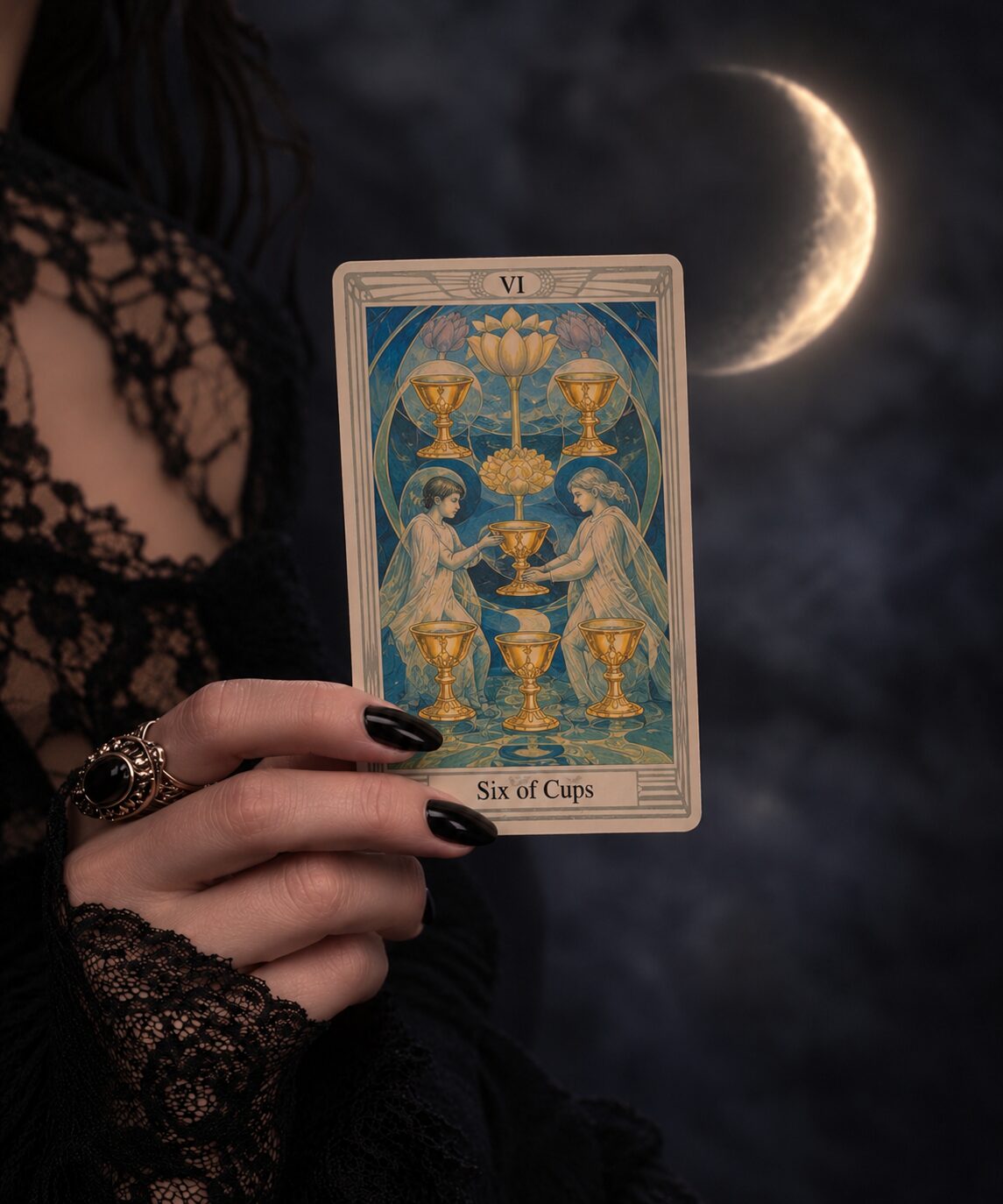
The Tarot card for this Scorpio New Moon is the Six of Cups, titled Pleasure in the Thoth Tarot.
This card represents emotional fulfilment, pure love, sensuality, inner harmony, and the ability to rediscover the joy of living without fear of vulnerability or surrender.
However, in Crowley’s interpretation, there is an important nuance: Pleasure is not fleeting gratification, the mere fulfilment of desires, or the satisfaction of the ego. It is a deeper state of inner harmony, in which our emotions, desires, and authentic nature are aligned. It speaks of the ability to receive love as freely as we give it; to feel safe in intimacy and to enjoy our own bodies, sensuality, and senses without guilt or the need for justification.
It speaks of opening our hearts again after disappointment, of restoring our trust in life, and of finding peace when we stop suppressing what we feel and allow ourselves to be who we truly are.
Blessings on the journey! ✨💛✨
-TEA
