

New Moon in Libra – Pluto direct!
New Moon at 17°21′ Libra : 10 October 2026, at 5:50 pm CEST
Before getting into the aspects, I want to follow the dispositor chain, because this is where the chart really begins to open up.
This is one of the things I love about astrology.
You start with a New Moon in Libra, thinking about relationships, balance and the Other, and before long you’re knee-deep in the unconscious, looking at the psychological baggage we bring into our relationships and, eventually, into the world we share.
There is quite a lot going on beneath the surface of this lunation.
We are not simply talking about a new cycle in relationships. We are looking at what those relationships reveal about us, the patterns we keep bringing into them, and what might finally need to change.
These themes will continue to unfold towards the Full Moon in Taurus, when the missing leg of the fixed T-square asks us to bring what we’ve come to understand into the reality of how we actually live.
But first, let’s follow the chain.
The Sun and Moon in Libra are disposed by Venus in Scorpio. From there, Venus and Mercury take us to Pluto in Aquarius, which leads to Uranus in Gemini, ruler of the North Node in Aquarius. Uranus, in turn, brings us back to Mercury in Scorpio, closing the loop at Pluto.Meanwhile, Mars in Leo, close to Pluto’s polarity point, and Jupiter conjunct the South Node in Leo bring another layer into the picture: individual identity, the need for recognition, familiar patterns of self-expression, and the ways our personal will plays out in relationships. Both are disposed by the Sun in Libra, tying these Leo placements directly into the new relational cycle.
The South Node in Leo speaks to familiar ways of expressing and identifying ourselves, while the North Node in Aquarius points towards something beyond the need to have our identity constantly confirmed. It asks us to make room for other people to exist as they are, with their own perspectives, desires and autonomy.
And with Uranus leading back to Mercury and Pluto, this is not simply a question of changing our behaviour on the surface. It goes deeper than that.
The chain closes at Pluto, which stations direct on 16 October, just four days after the New Moon.
I find this particularly meaningful.
What begins with Libra’s concern for relationship leads us straight into the unconscious patterns shaping how we relate, how we see ourselves, and how we participate in the collective.
The chart doesn’t really let us stay on the surface.
Pluto direct
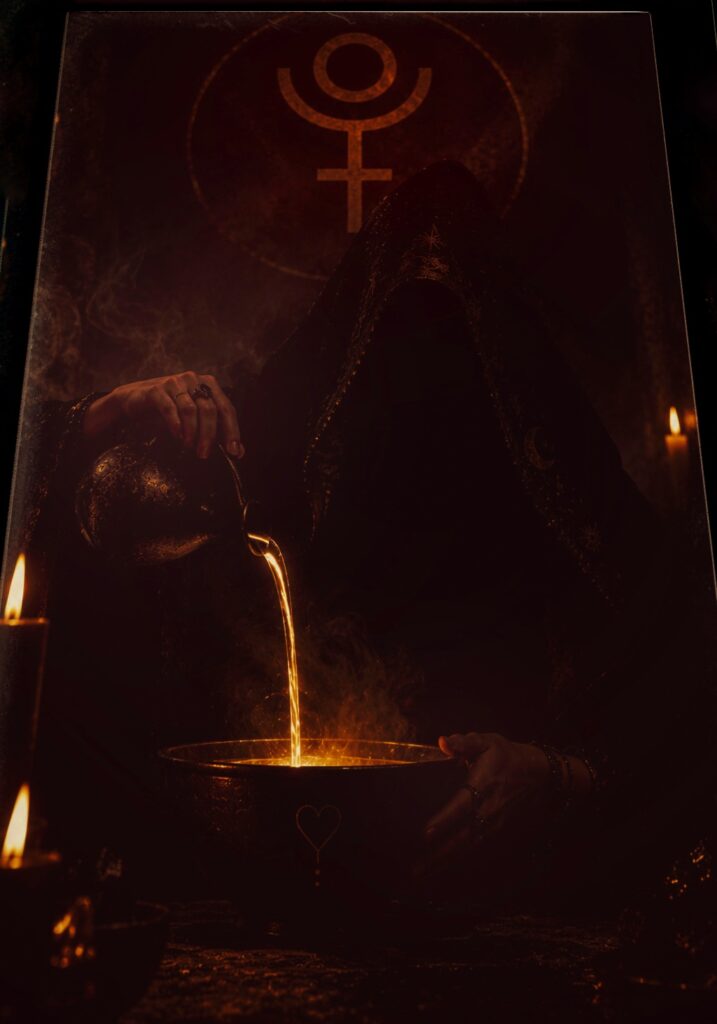
When Pluto stations direct, what we’ve been encountering internally starts asking to be dealt with differently in the outside world.
And with Pluto in Aquarius, the personal and the collective are impossible to separate.
The way we behave in our closest relationships, the things we refuse to acknowledge about ourselves, the beliefs we defend and the people we choose to blame are all part of the same picture.
Pluto in Aquarius sits at the heart of this dispositor chain.
With its station direct, something that has been brewing beneath the surface begins to find its way out.
Libra starts with the Other. With fairness, negotiation, listening, compromise and the question of how two people can meet without one having to disappear into the needs of the other. But Venus, Libra’s ruler, is in Scorpio, and Scorpio is rarely satisfied with the explanation we give on the surface.
It wants to know what’s actually going on. How did I develop these patterns? What did I learn about love, trust and intimacy, and where did I learn it? How do I communicate when I feel threatened? What happens when someone doesn’t give me the response I expect? And how much of what I call my personality is simply a collection of reactions I’ve never really questioned?
These are not always comfortable questions. But they’re worth asking.
There is nothing simple about Scorpio, and its complexity is a large part of why I created this blog. With natal Pluto in Scorpio in the 3rd house, exploring the layers beneath human expression has always been central to how I understand the world. I am interested in what lies beneath our words, our behaviour, our carefully constructed identities. The emotional undercurrents, the contradictions, the things we know but don’t want to know, and the distance that sometimes exists between how we see ourselves and how we actually behave.
That gap can tell us quite a lot.
Libra may ask whether something is fair. Scorpio wants to know why we keep choosing the same things and calling it fate. A slightly more uncomfortable question, perhaps.
But a useful one.
Meeting the collective Shadow
Pluto in Aquarius takes us from the personal into the collective, and this is where things get rather uncomfortable. Because the collective isn’t some abstract *them* out there. It isn’t separate from us, something we can point at, criticise and then walk away from feeling morally superior. The collective is also you and me. And this is where evolutionary astrology becomes particularly interesting. It asks us to look at the patterns humanity keeps reproducing, but also at our own part in them.
Not just what is happening in the world, but what allows it to keep happening.
The beliefs we defend, the fears we act from, the desires we refuse to question, and all the ways we participate in something without necessarily being aware of it. What within us keeps the monsters pulling the same old strings alive?
I’ve been hearing the phrase “history repeats itself” quite a lot lately. But I keep coming back to another question: what has actually changed within us? And what hasn’t?
There are still people who believe every lie fed to them by the mass media. People who would happily lynch the truth-teller, simply because he threatens the structure of belief upon which their identity depends.There are still people who deny their own shadow, while projecting it onto everyone around them. Ordinary men who look at little girls with lust and still manage to see themselves as respectable, moral human beings. People driven by envy, resentment and the unconscious desire to possess what belongs to someone else.There are still people who reduce sex to physical gratification, unable to recognise the psychic, symbolic and transformative dimensions of eros.There are still people who identify themselves with nations, flags, churches, political parties and presidents, as though belonging to something outside themselves could finally answer the question of who they are. And there are people who cannot distinguish their own thoughts from those of the collective. Who mistake belonging for truth, and the defence of an inherited belief for independent thinking. We project our darkness onto foreigners, heretics, minorities and neighbours, and then feel righteous condemning in others what we refuse to recognise in ourselves. Sometimes we’d rather destroy the person bringing an uncomfortable truth than allow that truth to disturb the story we’ve constructed about who we are.
Ambiguity is another problem. It asks us to remain present when we don’t have an immediate answer, to tolerate inner contradictions without rushing to resolve them. Yet so many people need everything divided neatly into heroes and villains, saints and sinners, good people and bad people.They cannot hold the tension. They cannot bear the possibility that the shadow belongs to the self, too. And so the search for salvation continues elsewhere. In money, status, sexual conquest, social approval, political allegiance, or whatever promises to give us a sense of identity and importance. Sometimes what we worship externally says quite a lot about what remains undeveloped within us.
This is Pluto.This is the collective shadow.
The collective is not separate from the individual psyche. It is shaped, in part, by the inner lives of the people who compose it: their fears, desires, unconscious motives, projections and the things they would rather not know about themselves.
In Jeffrey Wolf Green’s Evolutionary Astrology, this relates to the Consensus State, a stage of soul development in which our sense of identity is largely shaped by the family, culture, religion, social expectations and the need to belong all influence what we believe, what we desire and how we understand ourselves. We absorb ideas about what is right, what is acceptable, what makes us worthy of love and what might get us rejected. Eventually, many of these inherited ideas become so familiar that we stop recognising them as ideas at all.
They simply become “who we are” .
A person can defend a belief with absolute conviction without ever asking where it came from. And because these patterns are familiar, they can be remarkably difficult to see. Questioning them means risking something. Sometimes it means disappointing the people we love, losing our place in a group, or discovering that a belief we’ve built our identity around doesn’t hold up quite as well as we thought. This is not always a comfortable process. But it is part of becoming conscious of the forces shaping our lives. For as long as the shadow remains unconscious, it doesn’t disappear. It finds another ideology. Another century. Another war. Another political party. Another relationship. Another generation. Another body to inhabit. The monster survives because we keep feeding it with everything we refuse to know about ourselves.
I think this is one of the central questions of Pluto in Aquarius: What happens when humanity is finally forced to confront the unconscious patterns it keeps reproducing collectively?
If we understand evil, in this context, as something that can be sustained by unconsciousness, then the answer cannot simply be to become good in the most naïve sense of the word. It has to begin with consciousness. With the willingness to look inward and admit: This, too, belongs to me.
Not so that we can excuse harmful behaviour, identify with our shadow or abandon moral responsibility. Recognising our own capacity for destructive behaviour does not make us less responsible for what we do. If anything, it makes that responsibility harder to avoid. And recognising our own participation is not the same as excusing the actions of others.
It means taking back the part of ourselves we’ve handed over to projection, blame and the convenient belief that the problem always belongs to someone else.
Until then, the old gods and monsters will keep wearing new masks, the lizards will keep pulling the same old strings, and we’ll keep mistaking the repetition of unconscious patterns for the inevitable law of history.
The costumes change. The psychology underneath remains remarkably familiar.
And Pluto keeps asking whether we’re finally ready to notice.
Saturn In Aries : Who holds the authority ?
And this is where the New Moon becomes personal again.
Saturn in Aries, dispositor of Black Moon Lilith in Capricorn, opposes the New Moon in Libra. Alongside all the questions about relationships and the Other, another one comes into focus: Where have we given our authority away? How much of what we call connection is actually people-pleasing? And how often do we call something compromise when, deep down, we’re simply afraid of conflict? We wait for someone else to tell us what’s right, what we should want, how we should live, or whether we’re allowed to make a particular choice.
Sometimes we do this so automatically that we don’t even recognise it as giving our power away.
Saturn in Aries asks us to develop a more mature relationship with ourselves, our autonomy, responsibility and self-direction. Not the kind of independence that insists on doing everything alone, or the kind that mistakes every disagreement for an attack on personal freedom. Something more grounded than that: the ability to make our own decisions, stand behind them and accept that other people are entitled to do the same.
You are the authority you have been looking for. You make decisions about your life. You’re responsible for your choices, your boundaries and the direction in which you move.
Of course, this doesn’t mean we control everything that happens to us. We don’t. There are circumstances we never chose, things that happen beyond our control, and limitations that cannot simply be overcome through willpower. But there is a difference between recognising what we cannot control and surrendering responsibility for what we can.
Learning to tell the difference is part of the work.
And perhaps this is where Libra and Aries have something important to teach each other. A relationship doesn’t require us to abandon ourselves, just as autonomy doesn’t require us to disregard the Other. The question is whether we can remain in relationship without making someone else’s approval the condition for being ourselves.
Venus retrograde: What truly?
Venus retrograde brings us back to questions we may have thought we’d already answered. What do we actually value? What do we desire? What are we attached to, and why? What do we call love, and how often do we confuse it with intensity, possession or the fear of losing someone? Sometimes we remain loyal to something long after we’ve outgrown it. Sometimes we mistake the strength of an attachment for proof that a relationship is right for us. And sometimes we keep trying to make a connection work because admitting that it no longer does would mean confronting something we’d rather avoid.
Venus retrograde in Scorpio has a way of bringing these things to the surface.
Her journey through Scorpio and Libra, back through Libra before returning to Scorpio, unfolds over the coming months, taking us through a reassessment of our relationships, desires and values. What has become entangled may need to be unravelled. What we’ve been holding on to may need a closer look.
This isn’t necessarily about letting go of everything that feels difficult. Relationships have their complications, and intimacy asks something of us. The question is whether we’re working through something that can grow, or trying to preserve something that no longer reflects who we are.
Scorpio doesn’t open up easily. It wants to know that it’s safe before lowering its defences, and for good reason. It remembers betrayal. It remembers what happened the last time it trusted someone and discovered that vulnerability came at a cost.
The difficulty is that we can keep protecting ourselves long after the original danger has passed. We can mistake control for safety, and emotional intensity for intimacy. We can also become so accustomed to our defences that we no longer recognise them as defences.
Venus in Scorpio, squared by Mars and Pluto, can manifest in different ways – from intense devotion and magnetic attraction to manipulation, jealousy, envy, possessiveness, and obsessive behavior. Scorpio’s shadow rises to the surface, exposing hidden desires, insecurities, and power struggles.
What emerges could be uncomfortable, but it may also expose profound truths about the relationship: what binds two people together, what lies beneath the surface, and what needs to change.
This can become a turning point. For some, this process may lead to greater honesty. For others, it may reveal toxic patterns, secrets, unresolved power struggles, or fundamental incompatibilities that make it necessary to walk away.
And this is where Mercury in Scorpio enters the picture.
Something we’ve been repeating for years may finally begin to make sense. An old relational pattern, rooted in experiences we haven’t fully understood, may reveal why it keeps showing up in the present. What appears to be a problem with a particular person may have much older roots.
This doesn’t mean that every conflict is our fault, or that everything another person does is a reflection of our own unresolved material. It means that our responses, our expectations and the meanings we attach to other people’s behaviour are worth examining, too.
This is why honest conversations matter now more than ever.
Not because every difficult relationship should be saved, but because what we say, what we avoid saying and how we respond to one another can reveal a great deal about the patterns we’re caught in.
The point is to understand what keeps bringing us back to the same place.
Mercury in Scorpio leads us to Pluto in Aquarius. Pluto leads to Uranus in Gemini. Uranus brings us back to Mercury.
So, the mind is part of this process, too. Our assumptions, our interpretations, the stories we tell ourselves about other people – all of these shape how we relate.
And if we keep interpreting the same experiences through the same old assumptions, we shouldn’t be too surprised when the outcome looks familiar. This is one of the reasons I find this period so interesting from a psychological perspective.
We can spend years analysing a pattern, understanding where it came from and explaining why we behave the way we do. And yet, when the familiar situation appears again, we find ourselves doing exactly what we’ve always done.
Understanding something intellectually is not always the same as being able to respond to it differently.
Uranus in Gemini and Mercury in Scorpio offer the possibility of recognising the pattern while it’s happening – of catching ourselves in the moment, before the old reaction takes over completely.
And perhaps that small space between what we feel and what we do is something to pay attention to.
Mars sextile Uranus : Oops, I did it differently -and I like it!
This is the aspect I rather like for its potential to break a familiar pattern in an unexpected way.
Mars in Leo wants to act, express itself, create and follow its own impulses. Uranus in Gemini can disrupt the usual way of thinking, opening up a different perspective where there seemed to be none.Together, they can bring sudden realisations, original ideas and the courage to try something we wouldn’t ordinarily consider.
Sometimes change begins with a rather unremarkable moment. You catch yourself about to say the same thing you’ve said a hundred times, and then you don’t. You react differently. You make another choice. You realise you don’t actually have to keep doing something just because you’ve always done it that way. Oops. I did it differently. There’s something refreshing about that.
Uranus challenges patterns that have become too restrictive for the life trying to emerge. With Mars in Leo, there is also room for creative expression, spontaneity and the courage to act on something that feels genuinely your own.
And this fits beautifully with the larger dispositor chain. Uranus in Gemini leads us back to Mercury in Scorpio, close to Venus.
So the willingness to do something differently doesn’t exist in isolation. It feeds directly into the way we communicate, understand one another and navigate intimacy. Our words can become bridges between two people. They can also become walls.
And sometimes the difference isn’t in the words themselves, but in what we’re trying to achieve by using them. Are we trying to understand, or to win? Are we genuinely listening, or just waiting for our turn to explain why we’re right? Can we admit that something hurt us without turning the conversation into a trial? Can we say what we actually mean, even when it makes us feel exposed?
Sometimes the most radical thing we can do is have an honest conversation without trying to win it.
Or simply admit what’s going on.
I know. Very radical.
Jupiter in Leo Conjunct the South Node
Jupiter conjunct the South Node in Leo brings familiar patterns of identity, recognition and self-expression into the picture.
With both placements disposed by the Sun in Libra, conjunct the Moon, these themes connect directly with the New Moon and the relationships through which we come to understand ourselves.
In evolutionary astrology, we might look at this as a familiar way of seeking meaning, love and validation through our identity and the role we occupy in another person’s life.
We may want to be loved in a particular way. To have a special place in someone’s world. There’s nothing inherently wrong with these desires; we all want to matter to the people we love.
The difficulty begins when our sense of worth becomes dependent on receiving a particular response. Sometimes generosity and loyalty are genuine expressions of love. At other times, we may give a great deal while quietly expecting something in return. We may become attached to the role of the devoted partner, the indispensable person, the one who always gives us what we want and struggle when the other person doesn’t respond in the way we believe they should.
We can even confuse being needed with being loved.
And when the other person has their own needs, desires or direction, we may experience their autonomy as rejection.This is one of the tensions Jupiter conjunct the South Node in Leo can bring into relationships: the difference between expressing love freely and needing the relationship to confirm something about who we are.
With the Sun in Libra conjunct the Moon, the past and the new relational cycle meet in the same place. Familiar emotional responses may surface through a partner, bringing old expectations, pride or the need for recognition into view.
A relationship may show us where we’re still looking for something outside ourselves to settle a question we haven’t quite answered within.
The sextile between the New Moon and Jupiter offers room to approach these patterns differently.
This doesn’t necessarily mean beginning a new relationship. It may be a turning point in an existing one, a more honest conversation about what each person needs, or simply the recognition that a familiar dynamic has been repeating itself regardless of who we’re with.
Jupiter conjunct the South Node brings us back to what we know.
The New Moon in Libra opens a new cycle through relationship. The sextile connects the two, offering the possibility of doing something differently with what we’ve inherited.
Whether we take that opportunity is another matter.
Towards the Full Moon in Taurus
The intense T-square involving Venus, Pluto and Mars brings considerable pressure to the themes we’ve been exploring. But every T-square has a missing point, and here that point falls in Taurus.
Scorpio takes us into the depths. It shows us the attachments, emotional patterns and power dynamics we may have preferred not to examine. Taurus brings us back to a rather practical question: now that we can see what’s happening, what are we going to do about it?
Because insight, on its own, doesn’t necessarily change anything.
We can understand why we react the way we do, recognise where our fears come from and see how the past continues to shape our relationships, only to find ourselves making the same choices when something familiar is threatened.
I think most of us know what that feels like.
Real change begins to take shape when our understanding starts to influence how we live. What we tolerate. What we value. The boundaries we establish. The choices we make when the old pattern presents itself again.
Taurus, in it’s best, brings us back to the body, to everyday life, to what we actually build and sustain over time. Not what we promise ourselves we’ll change, but what our actions reveal about what matters to us.
The upcoming Full Moon in Taurus, in late October, will also be ruled by Venus, but this will be a different Venus. The reassessment that begins here will have had more time to unfold.
We may have recognised something about a relationship. The question is whether that recognition will change the way we live, or whether we’ll return to the familiar simply because it’s familiar.
We don’t have to transform everything overnight. Taurus reminds us that lasting change often happens through small, consistent choices. Through the things we stop doing, the things we begin to practise, and the things we are no longer willing to sacrifice simply to keep the peace.
So, the question isn’t only what needs to change.
It’s what we’re actually prepared to do differently now that we know.
Our next Full Moon takes us there.
Until then,
Blessings on the journey!
🤍
-TEA