

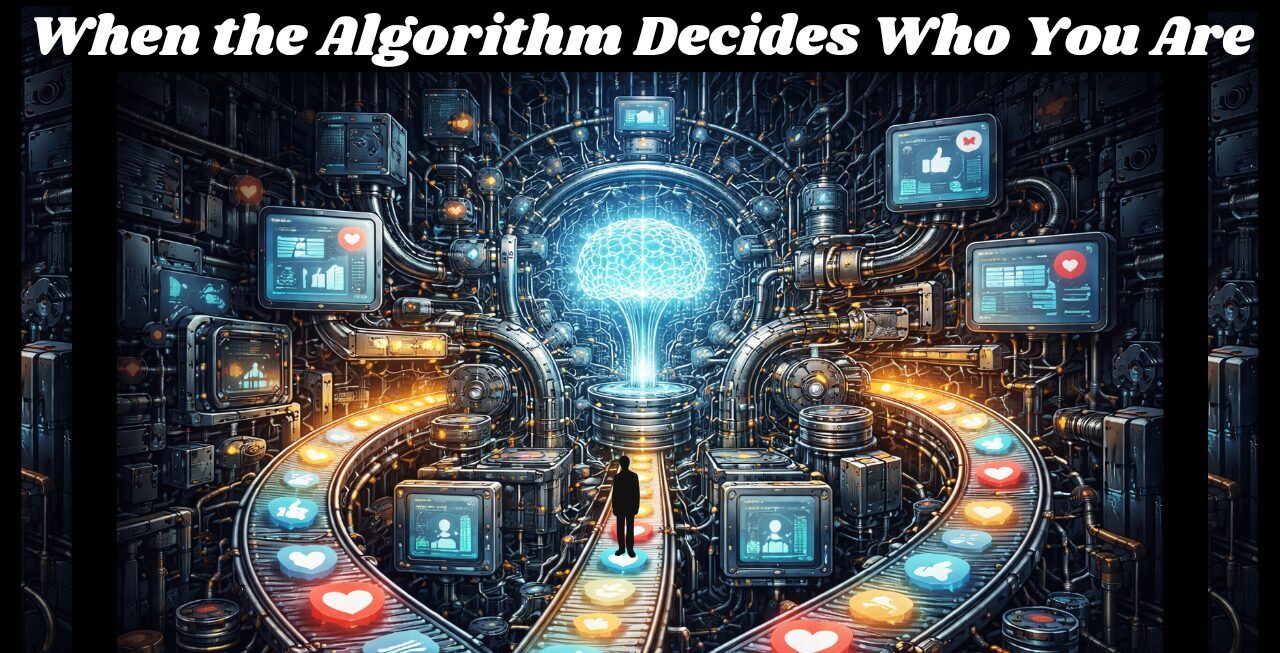
When the Algorithm Decides Who You Are!
The culture of social media implicitly suggests that clarity of identity is necessary for visibility.
If we engage in different things, it is expected that we separate them: into profiles, niches, and carefully curated roles. This approach is not only technically supported — it is systemically rewarded.
Social media emphasizes recognizability and clarity: algorithms favor content that is easy to classify and share.
The consequence is a fragmentation of identity: people feel they must “fit” themselves into niches, just as they separate profiles by interests or roles by activities.
At a psychological level, however, this logic is far from neutral.
What is separated and curated on social media are personas.
A persona represents a social mask: the way an individual adapts to collective expectations in order to function in the world. The persona itself is not pathological; it is a necessary mediator between the inner and outer world.
The problem arises when we identify too closely with the persona — or when we multiply them to the point that they become mutually disconnected. (a.k.a. multiple profiles or YouTube channels).
Then identity no longer functions as a whole, but as a series of parallel performances that rarely interact.
Algorithmic systems cannot handle complexity. They favor clarity, repetition, and recognizability.
Such logic is technologically understandable but psychologically reductive.
The consequence is not freer expression, but the fragmentation of the experience of self.
Parts of personality become separated as if they are not allowed to coexist — as if the creative, spiritual, rational, and everyday aspects do not belong to the same person.
The Jungian Self does not represent a single role or persona, but a principle of wholeness. It does not appear where identity is simplified, but where different aspects of personality can be integrated.
The problem has never been having too many interests, but the belief that they must be separated in order to be acceptable.
Imagine a Renaissance person today having to fit all their interests into algorithmic niches.
Thus, integration, not segmentation, remains the psychologically more mature response.
Being whole today often means being somewhat messy, hard to categorize, and algorithmically unreadable.
But this is precisely where the psyche remains — whole.
By Tea Franca